First edition · 2026
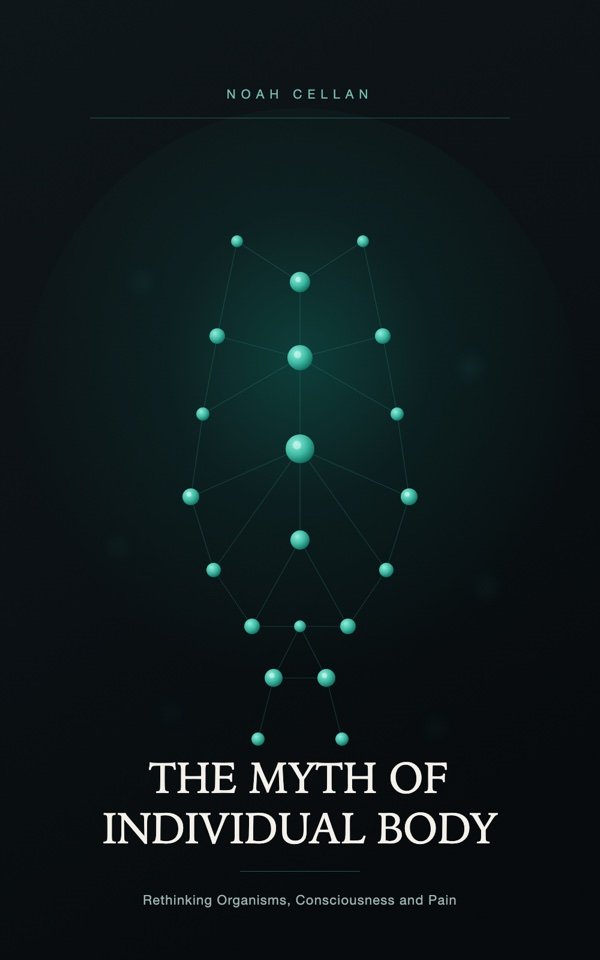
The Myth of Individual Body
Rethinking Organisms, Consciousness and Pain
In The Myth of Individual Body, Noah Cellan challenges the very idea of individuality. Every body, every organism, is not a single entity, but a bustling colony of living beings. Cells communicate, cooperate, and even “rebel” — generating intelligence, signaling danger, and shaping the experience of life itself. Disease, pain, and consciousness are not punishments or accidents, but expressions of the colony in action.
This book reveals the hidden society inside you and asks: what does it mean to be alive?
From the preface
This book did not begin as a rebellion against biology. It began as a quiet discomfort with something simpler: the way we speak about living beings. From the preface
Over time, biology itself has been quietly undermining the tidy story of the individual — not with philosophy, but with observation. Communication pathways. Signaling cascades. Distributed decision-making. Cellular cooperation and cellular rebellion.
These chapters follow that realization to its conclusion: that what we call a multicellular organism may be better understood as a colony of living beings, cooperating under shared constraints. None of it requires abandoning science. It requires following it more honestly.
Contents
Ten chapters
Each chapter opens with a line that states its case. Here they are in order.
-
01
What is an Organism?
We speak of bodies as if they were singular beings. But what if the individual was never real — only convenient?
-
02
The Cell: The True Living Unit
A cell does not wait for instructions to live. It eats, reacts, repairs, decides — and survives.
-
03
Multicellular Bodies as Cellular Colonies
A single cell can live alone. A multicellular body cannot.
-
04
Evolution of Cooperation Among Organisms
Specialization does not erase agency. It amplifies survival.
-
05
Consciousness as a Collective Phenomenon
Thought appears not where control is strongest, but where interaction is richest.
-
06
Death Reconsidered
What dies — the organism, or the arrangement?
-
07
Humans, Identity, and the Illusion of Self
The self becomes a story told by many voices, none of which speak alone.
-
08
Modern Science Quietly Agrees
The revolution already happened. It just wasn’t announced.
-
09
Implications for Medicine and Intelligence
The colony signals distress not to suffer, but to survive.
-
10
A New Definition of Life
Life is not a thing. It is a pattern that holds — until it doesn’t.
Book details
- TitleThe Myth of Individual Body
- SubtitleRethinking Organisms, Consciousness and Pain
- AuthorNoah Cellan
- EditionFirst edition, 2026
- Pages82
- Chapters10
- LanguageEnglish
- ISBN9798247820833
- ASINB0GMV5PH5L
- PublisherPublished independently
Where to buy
Amazon
Available as a Kindle edition. Buying through the author page also shows any other titles as they are released.
A note on scope: this book is intended for educational and philosophical discussion. It does not provide medical, diagnostic, or therapeutic advice.
Questions
What readers ask first
Is a human body one organism or many?
The book argues a multicellular body is best understood as a colony of living cells rather than a single being made of parts. Each cell metabolizes, maintains internal order, communicates, responds to signals, and can reproduce — meeting every classical criterion for life on its own. Individuality, on this view, is graduated rather than binary.
Does this book reject mainstream biology?
No. Its claim is that these ideas do not require abandoning science but following it more honestly. It draws on established observations — cellular signaling, programmed cell death, endosymbiosis, distributed decision-making — and argues that biology has already been quietly undermining the individual-body narrative.
What does the book say about cancer?
Cancer is framed not as a foreign invader but as a lineage of cells that has opted out of cooperation — prioritizing its own reproduction, ignoring communal growth limits, exploiting shared resources. In social terms it reads as rebellion rather than malfunction, which only makes sense if cells were autonomous participants to begin with.
Do I need a science background to read it?
No. It is written for general readers, defines its terms as it goes, and builds its argument in plain language across ten short chapters.
Is the book medical advice?
No. It is intended for educational and philosophical discussion only, and does not provide medical, diagnostic, or therapeutic advice. Consult qualified professionals regarding medical or health-related matters.
Read the book
Once this is seen, it cannot be unseen. Final takeaway